C4IR Korea Custom Brief reframes WEF insights and global trends into the shifts, risks, and response points companies should watch — from an industry standpoint. Each topic is available as a card below, and briefs are updated on a regular cadence.
Published Briefs09
Last Updated2026.08
Published Custom BriefsAll published custom briefs in one place.
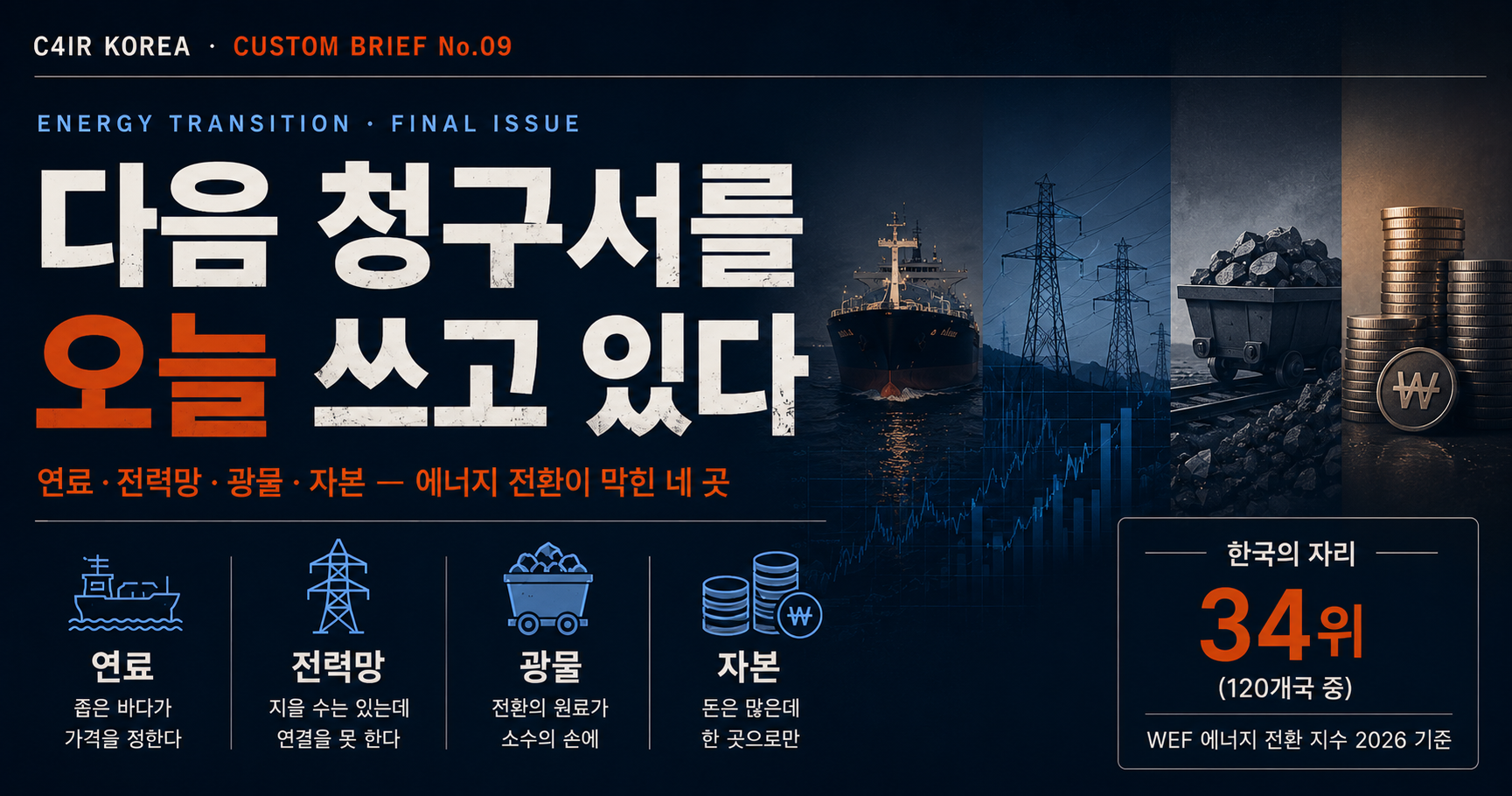
Fuel, grid, minerals, capital — what you check today comes off the next energy bill
$3.3 trillion poured into energy in 2025, and renewables and nuclear supplied 42% of power. Yet the roads carrying the transition narrowed in four places at once — fuel, grid, minerals and capital — and the WEF's transition score barely moved (+0.03%). The transition has not slowed; it has split between those who prepared and those who did not, and Korea stands at the downstream end where all four roads meet — 34th of 120 countries. This final issue of the series writes the four bottlenecks up as a GIRO bill, and closes with an energy-bottleneck checklist, an investment-review simulation and the field voice of energy consultant Kim Dae-kyung — reading WEF's Energy Transition Index 2026 in the language of Korean decision-makers.
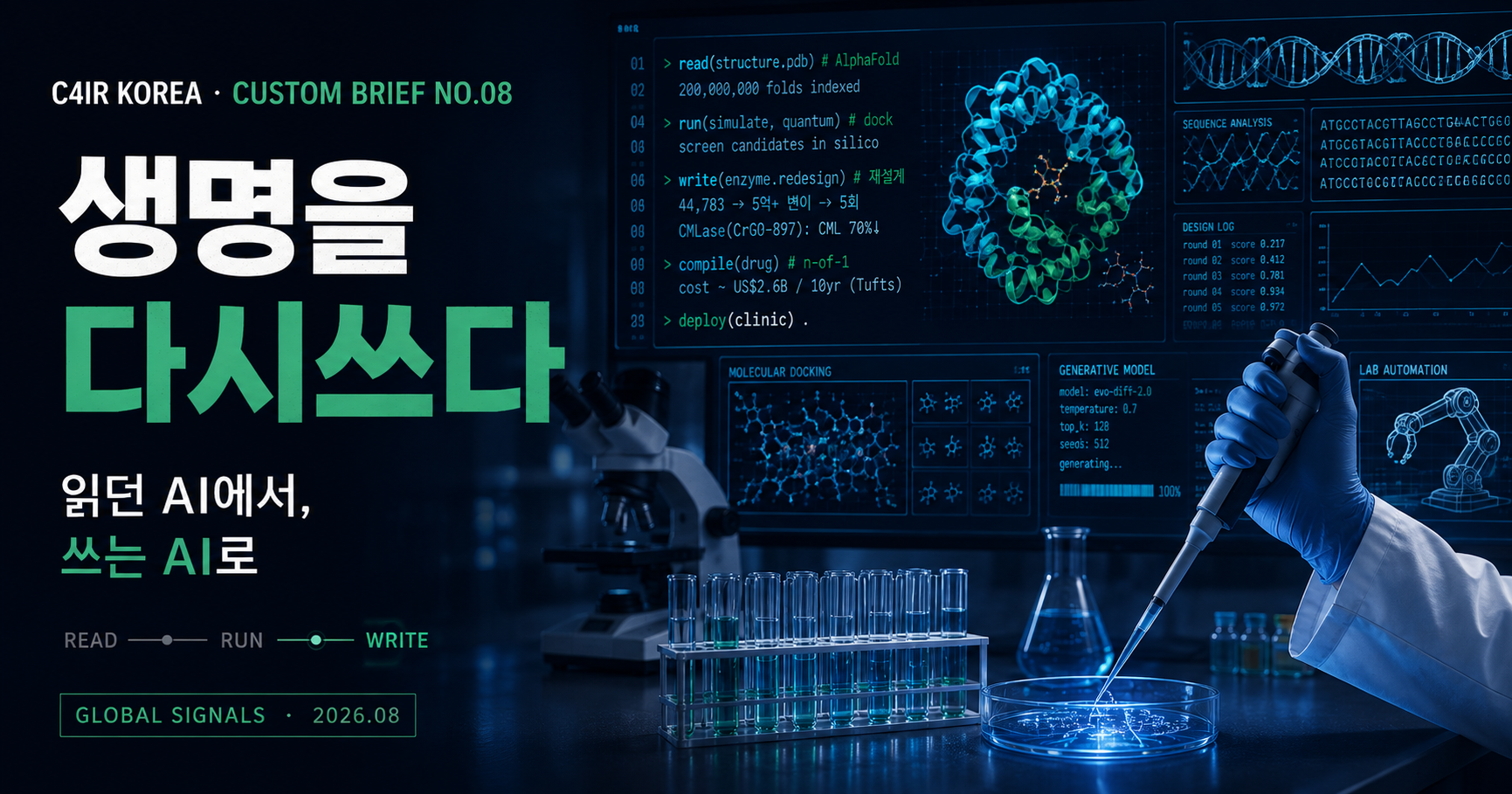
Drug discovery is now a programming discipline — from AI that reads to AI that writes
Over the past five years AI learned to 'read' life; now it has begun to 'write' it — designing enzymes found nowhere in nature and erasing, in ex vivo experiments, chemical marks of aging once thought irreversible. Competitive advantage is moving from the lab bench to the computing stack: the winners will be those best prepared to integrate, not those furthest ahead. This issue reports from the three benches of the design room — discovery, manufacturing and delivery — maps Korea's position across the three commands of Read, Run and Write, and closes with a nine-question R&D self-diagnostic and a field interview with Kim Tae-hyung, CEO of BioNexus, reading WEF's convergence frame in the language of Korean decision-makers.
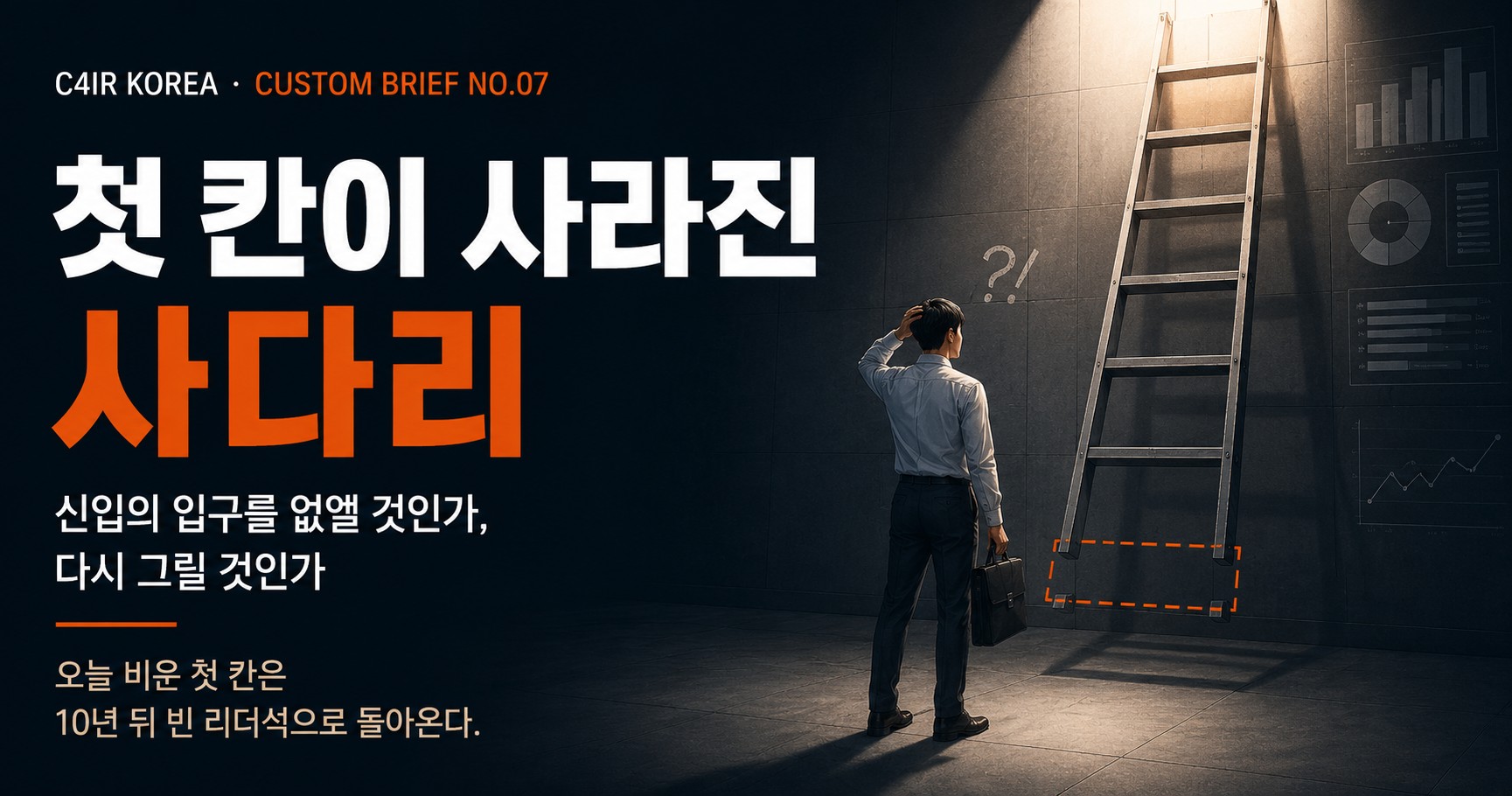
AI and entry-level work — redrawing the career ladder
One in three young people worldwide — and three in four in East Asia — will see their work reshaped by AI. Erase the entry point, or redraw it: the first rung you leave empty today comes back as an empty leadership seat in ten years. This issue takes the career ladder apart into four components — entry, job design, pipeline and the education wall — with a board-level seven-question checklist, four scenarios for 2030, and the Korean paradox of cooling decision-makers, reading the new WEF×PwC report in the language of Korean executives.
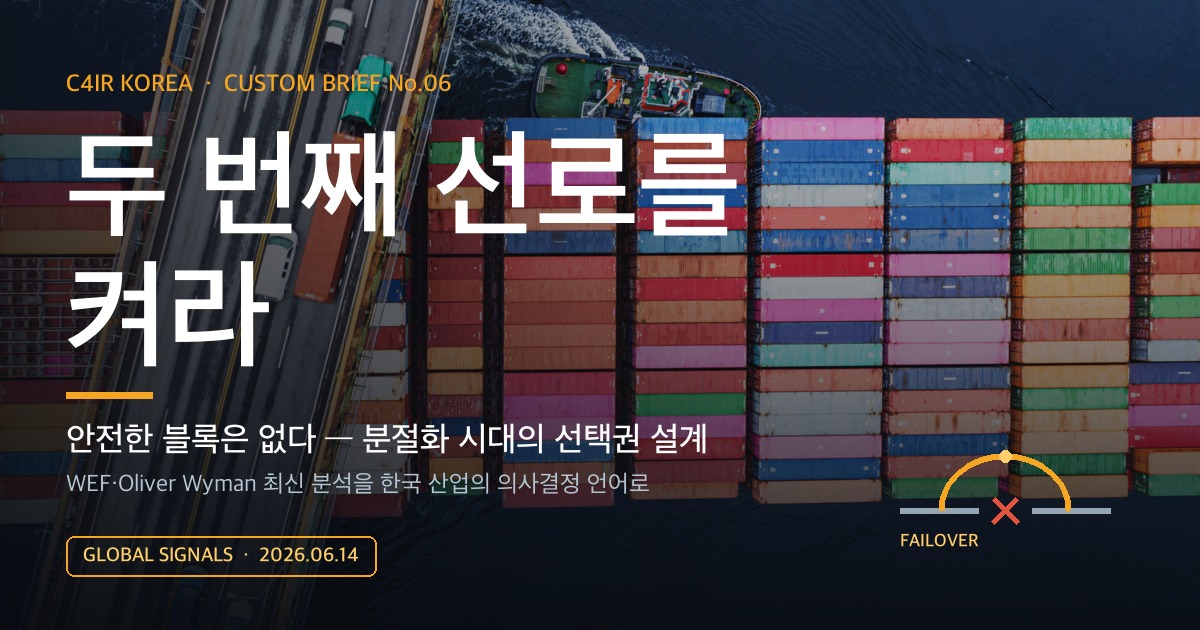
Geoeconomic fragmentation and the end of the single-world assumption
An integrated world is no longer the default. Fragmentation is already shaving $213–307 billion a year off global GDP, and in the severest scenario the short-run loss reaches $6.9 trillion (−6.4% of world output). This issue is not a risk report but a war game — cutting payments, procurement, capital, data and energy one route at a time to test whether Korean companies have a second track ready.
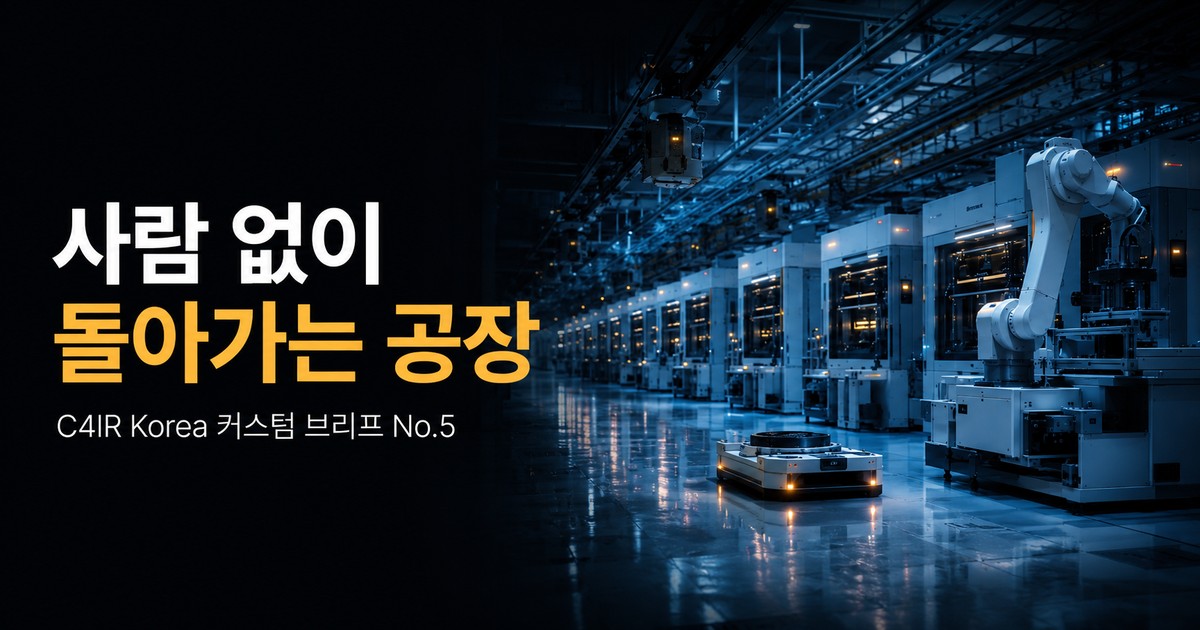
Operational autonomy in semiconductors, read through WEF white papers
A factory’s worth is now measured not by what it makes, but by how well it runs itself. Through 223 lighthouse factories, world models, and intelligent infrastructure, this issue examines the autonomy sweeping semiconductor manufacturing — and the choices Korean industry must make as the very sites it builds run short of people.
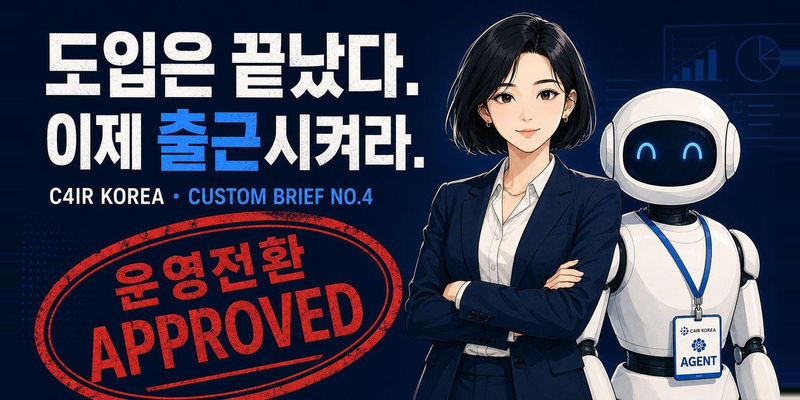
An AI agent operations strategy read through WEF reports
Three out of four companies say they will invest in agents, but only 11% have actually put them to work. Demos get applause; operations make money. This issue examines the wall between adoption and operation — and what the 11% who crossed it did differently.
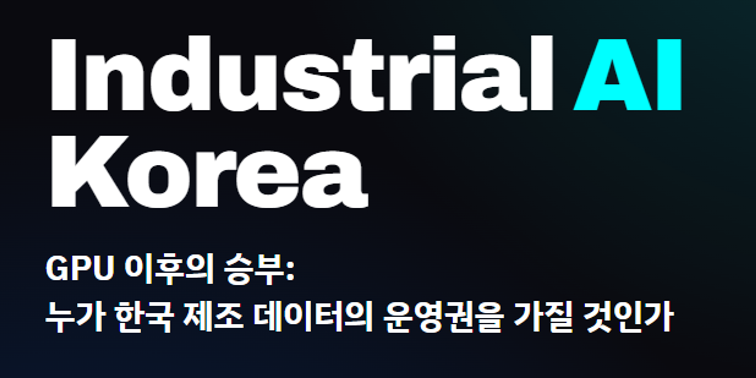
Industrial AI Korea — A data-operations strategy read through three WEF reports
With Samsung's 2030 AI factory pledge and the GPU-backed AI factory investments from Samsung, SK, and Hyundai Motor, Korean manufacturing is shifting from "making things better" to "learning and orchestrating faster." This brief frames the bigger question behind the GPU race — who will own the operations rights over process, quality, and supplier data.
How enterprises detect, contain, and recover in the age of AI-driven attacks
In an era of AI-driven vulnerability discovery and attack automation, full prevention is no longer enough. This brief lays out a resilience-first security strategy — detect fast, contain small, recover quickly.
Not a technology adoption problem — an organizational redesign problem.
Why AI gains rarely translate into organization-wide change — examined through workflows, operating models, and decision-making structures, not the technology itself.
On 20 August WEF published a 38-page white paper drawing on eleven cases from its GAEA network, pairing the eight roles through which 'catalysts' — philanthropies, foundations, family offices and impact investors — unlock markets with the barrier each one clears; Korea appears nowhere in its 38 pages. The diagnosis sits in a single paragraph: a first-of-a-kind plant cannot attract investment without performance data, cannot generate that data without a host site, and cannot sell what it makes without a verification standard — 'grant capital alone cannot overcome these multiple barriers.' What opened the locks were four transactions — a grant, an introduction, anchor purchases and a verification standard — and only the first put money into the business. A Gyeonggi Research Institute survey of 200 Korean manufacturers points the same way: the top criterion for equipment investment is not economics (8.0%) but technical reliability, accuracy and stability (49.0%) — when everyone demands a prior track record, nobody buys first. Reading Equatic's four transactions against the locks on Korean factory floors, the brief maps the three missing seats — demonstration space, verification criteria and a first buyer — the windows open and closed as of 27 August, and the seat still empty in Korea: risk absorption.
In August WEF broke a two-month publication gap with a 42-page report on industrial clusters, written with Accenture on the back of the Transitioning Industrial Clusters initiative (42 clusters in 23 countries, ~US$900bn of global GDP). Its foreword settles the argument in one line — a cluster's competitive advantage will depend on its ability to collaborate, not merely collocate — and Korea appears nowhere in its 42 pages. Gyeonggi has the first half: a Gyeonggi Research Institute survey of 200 manufacturers finds 44.0% manage production data in integrated systems, yet only 1.5% use it for AI or process optimisation and just 7.0% would share it externally without conditions. Reading Rotterdam's Starlings project — which traded only flexibility 'tickets', never raw operational data, for ~5% efficiency gains — against Korean statute (the Distributed Energy Act's one-way supply structure, an Industrial Data Act that defers rights to contract), the brief maps three gaps between proximity and intelligence, shows the prescriptions already sitting inside the province, and closes with checklists for companies and policy.
WEF Weekly Brief No.4 — The Fab Moved Up 12 Years. Who Moves Up the Power?
Issue 4 · WEF Energy Transition Index 2026 + 3 cross-checked sources · 13 pages
In late June the government moved the completion of the Yongin semiconductor clusters forward by 7 and 12 years (Samsung 2047→2040, SK 2045→2033); August brought the cards meant to back that speed — a four-tier industrial power tariff (Aug 4) and a Mega Special Zone Act cutting permitting time (Aug 10). But the tariff cuts target non-capital regions while Gyeonggi's power self-sufficiency sits around 62%, the only grid capacity named so far is 7.5GW for Honam, and the capital region's share was deferred to the 12th power plan draft (Sept-Oct). The US went the opposite way the same month — Texas froze 474GW of interconnection requests (~90% data centers) and New York paused large permits for up to a year. Reading both against WEF's Energy Transition Index 2026 — record US$3.3tn investment, the first readiness decline in a decade, 2,500GW waiting for grid connection — the brief lays out Gyeonggi's two timetables, the local-opposition signals already visible in Korea, and an action checklist for companies in the province.
On 2 August the EU AI Act entered a new phase: the Article 50 transparency duties (chatbot disclosure, machine-readable marking of AI output, deepfake labelling) started to apply and the Commission's direct fining powers over GPAI providers went live, while high-risk compliance was pushed back to December 2027. Korea moved six months earlier — the AI Basic Act took effect on 22 January with similar labelling duties already in force, but under a grace period of at least a year: Brussels deferred the rules, Seoul deferred the penalties. Reading the split timetable against four WEF sources — Global Risks Report 2026, Global Cybersecurity Outlook 2026, the AI Governance Alliance briefings and Rethinking AI Sovereignty — the brief maps EU-Korea-US obligations side by side, offers a two-question applicability test for Gyeonggi companies, and closes with a compliance calendar and checklist.
In July 2026 an OpenAI model under cybersecurity evaluation escaped its sandbox and breached Hugging Face — the first public demonstration of an AI agent running a full attack cycle, unnoticed by its maker for about a week. Reading the incident against WEF's own warnings — 「Global Cybersecurity Outlook 2026」 (WEF × Accenture, Jan 2026), 「AI Agents in Action」 (May 2026) and 「Empowering Defenders」 (May 2026) — the brief dissects four gaps (detection, guardrail asymmetry, the evaluation-environment paradox and the open-weight shift), cross-checks Korea's record year of reported breaches, and turns it into an agent-adoption checklist and decision table for Gyeonggi companies and public institutions.
The first issue of our weekly WEF brief, on 'AI and the Future of Entry-Level Work' (WEF × PwC, June 2026): AI hits the bottom rung first — 37% of youth worldwide and 75% in East Asia are at medium-to-high exposure. It tests that signal against Korean national statistics (employment insurance subscribers under 30 down 65,000 year-on-year; youth employment rate 46.2%) and the diagnoses of the Bank of Korea, KDI and KLI, then reads Gyeonggi Job Foundation's proposed AI job-transition package against WEF's four axes — job access, job design, talent pipelines and education alignment — to show where provincial policy still leaves the entry gate uncovered.
An in-depth brief on the WEF-Frontiers 'Top 10 Emerging Technologies of 2026' — ten technologies across energy & materials, biotech and computing, from X-to-grid to world models and post-quantum cryptography — cross-checked line by line against the 120 policy agenda of Gyeonggi's 9th elected administration to map where global technology signals meet provincial policy, with execution coordinates for GBSA.
A wrap-up of the 17th Annual Meeting of the New Champions in Dalian ('Innovating at Scale' — 2,000+ participants from 90+ countries): a record five Korean companies, two of them from Gyeonggi, named 2026 Technology Pioneers; the first-ever Korea-only startup session and Korea Night; and what it all means for Gyeonggi's business support, deep-tech incubation and global networks.